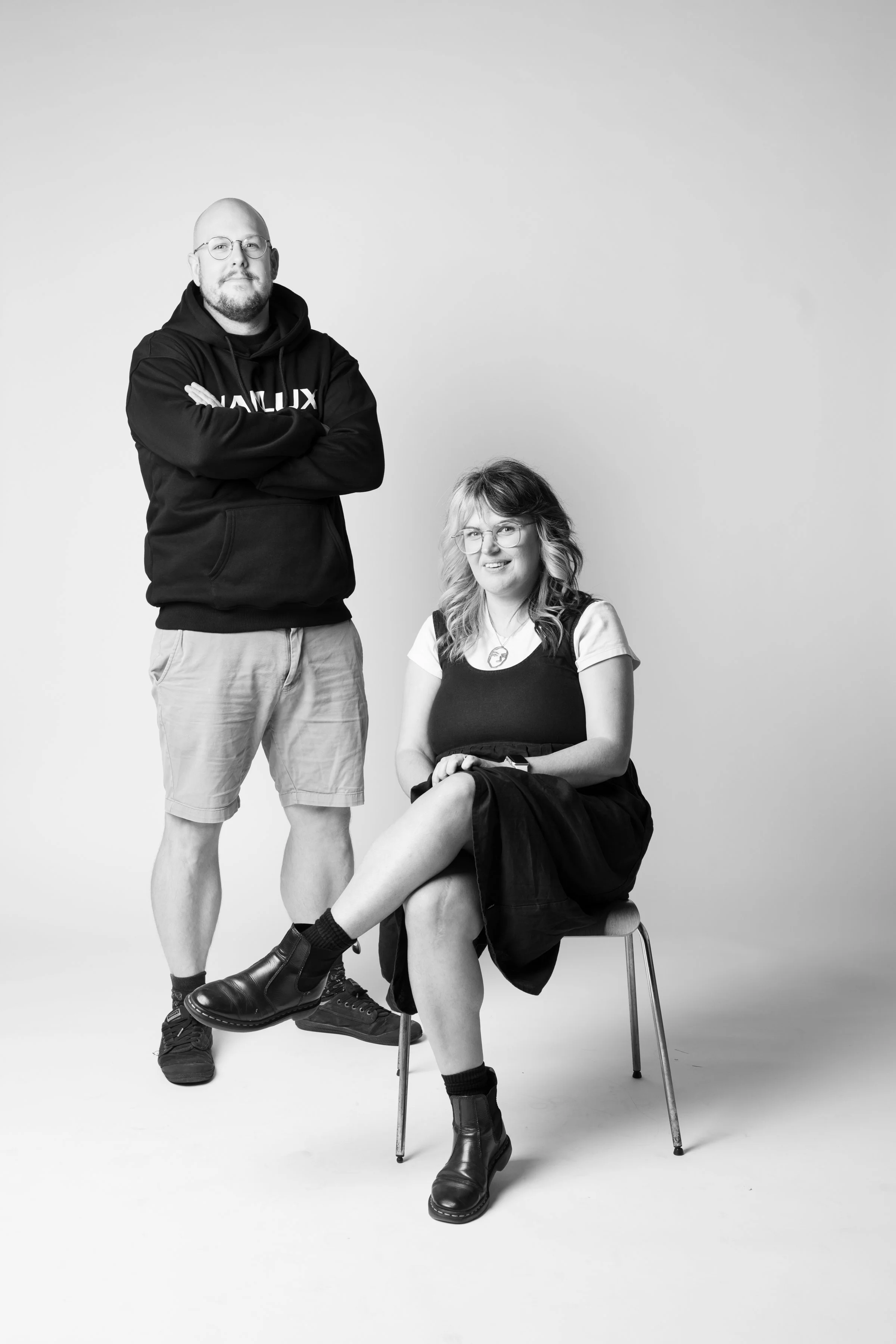
Chris Bowes & Jade Richards-Butler - Kindred Cameras Owners
Chris
Q: Why did you start the studio?
A: It’s a long story, so it might take the whole 20 minutes. Jade and I worked together at Michael’s running the media school—that’s how we knew each other. When Michael’s shut down, we were both looking for something new and really wanted to create a place where we could keep running workshops. The original idea for Kindred Cameras was purely as a workshop business.
We applied for a post-COVID revitalisation programme hoping for a small space to run workshops from. For about 18 months nothing happened, and then, right at the end of the program, they said, “We think we have a space for you.” They showed us this place and it was much larger than we expected. So the idea evolved into creating a kind of artist-studio/photo-studio hybrid—an affordable, flexible space for photographers.
That was the start. A lot has happened since, but the core philosophy of keeping the space affordable has remained.
Q: And how’s it going?
A: It’s alright—we’re still here! It’s been three years. Things could be better, for sure, but every year gets a little bit easier. For me, the big question was always: Can you make a place that is sustainable AND affordable? Because I don’t have yacht-and-caviar ambitions—I just want to be comfortable. We’re not at the sustainable stage yet, but I still think it’s possible.
I do seem to be getting busier, but I’d love to hire an employee one day. That’s the dream. It’s a lot of work running this place, and there’s so much I’d rather be doing creatively. The workshops are finally launching—only three years late! I’ve been working on the marketing this morning. It’ll be a great milestone.
Q: When you were at school, were you always headed toward photography or the arts?
A: Not at all. My aspiration at school was to be an investment banker. I studied maths, accounting, and economics, then did a maths and finance degree at university. During that time, I had a bit of a quarter-life crisis and got obsessed with keeping pet fish—I had about 10 or 12 tanks at one point. I bought a camera to take photos of the fish, and that got me into photography.
When I was about 24, I thought, “Fuck it, I’m going to try something more interesting than banking,” and I went down the photography and arts path. Never really looked back.
Q: Do you consider yourself a photographer or an artist?
A: Depends on the day. I think at heart I’m an artist. Photography and art can be distinct or the same depending on what you’re doing. On Monday, for example, I was photographing other people’s artworks—that’s just technical documentation. It’s dry, no creative input, just good captures.
But when I’m making work for myself, or for Instagram, or I’m teaching at RMIT—that’s art. Then the concept comes first.
I actually have a pure love of photography. I think it’s the most important creative medium humans have invented since the written word. I love that it’s so broad—you can dive deep into the technical side, or deep into the conceptual and philosophical side. So I’m happy being both: photographer and artist.
Q: Where do you see your own future heading? Not the studio—you.
A: Content creation. I tell everyone I’ve retired from the arts and become a content creator, and honestly, I fully embrace it. The art world looks down on content creation, but for me it’s all the fun of making art without the baggage—no grant proposals, no exhibitions to organise.
I’ve always been hesitant about social media, but now that I’ve embraced it, it’s reinvigorated my creativity. And I love teaching—if I could teach all the time, I’d be extremely happy. That feels like home.
So after three years of doing things at the studio that I never actually planned to do, I’m finally getting to realise a bit of that original dream.
Q: Brilliant. Good on you.
A: Thanks. That’s it.
If you’d like this compiled with the rest of the interviews, or want an intro/outro added for a book or exhibition, just let me know!