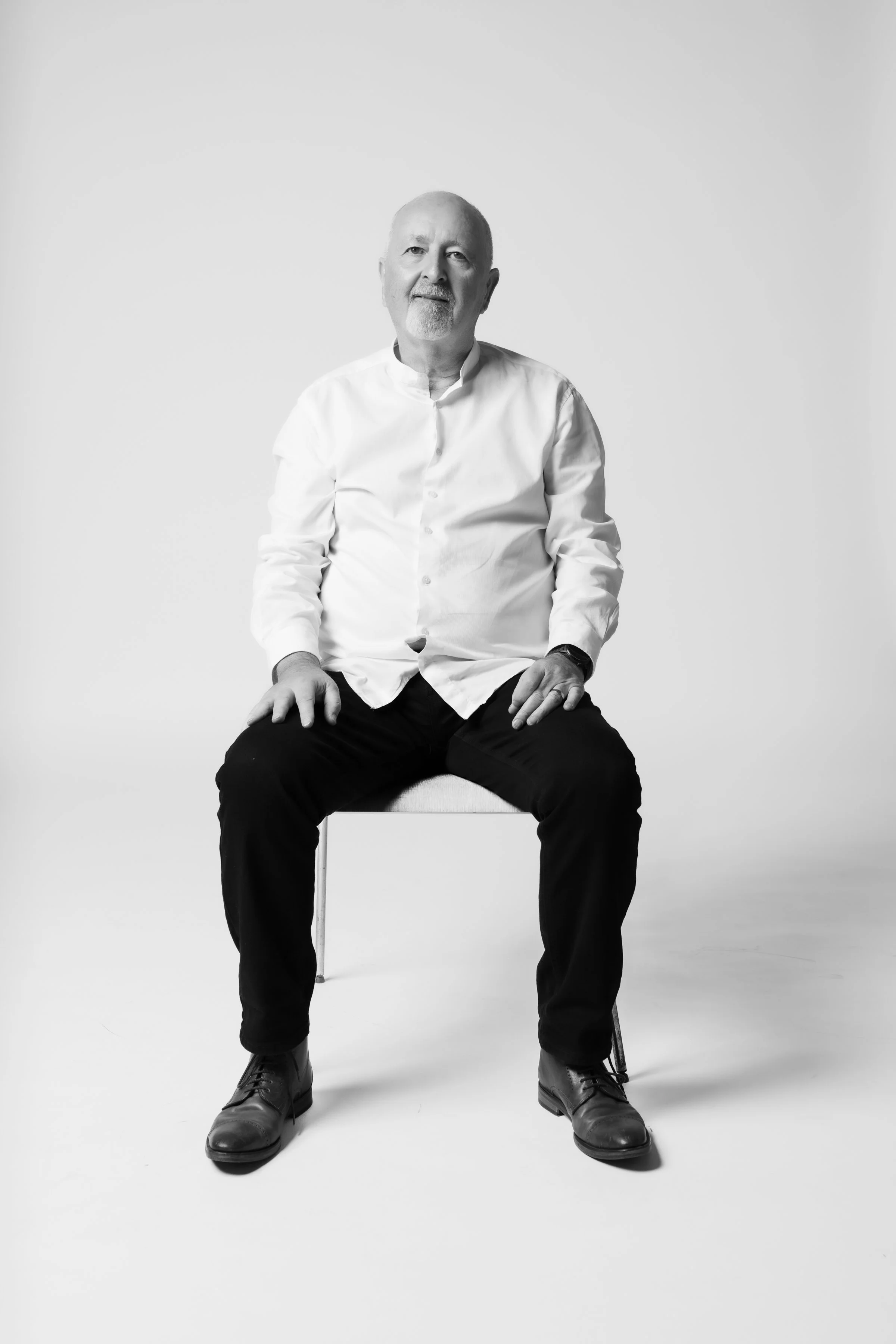
Gerry Gaffney - Friend, UI/UX Designer
Q: Let’s start with growing up in Ireland. What was your childhood like?
A: Pretty normal, really—or at least it felt normal to me. Four kids in the family, and I was the eldest boy. My sister was older. It was a very traditional Catholic Irish upbringing in a small town called Longford. When I explain it to Australians, I usually say it’s like Bendigo: decent-sized but still with that country-town feel.
I enjoyed school at first, had good mates, but by the middle of high school I absolutely hated it. From my teens onward, I drifted a bit—went my own wayward way for a while.
Q: Did the Troubles have any impact on your life?
A: Not really, to be honest. Even though the border was only 50 miles away and we were very aware of what was happening, none of my friends or family were involved in anything political or paramilitary. Most people in our circles wanted a united Ireland in principle, but not through violence.
I remember a Belfast guy I later worked with in Dublin—very much a nationalist—once said, “I’d like to see a united Ireland, but don’t hit anyone over the head with a brick.” A great line in a lovely Northern Irish accent. He also once said of Van Morrison, “Is he the guy you can’t understand anything he says?” Brilliant.
Q: What drew you to Australia?
A: My then-wife had a job here, so that was the catalyst. But immigration from Ireland was incredibly common then. The economy was pretty fucked—high unemployment, very pessimistic outlook—so a huge number of people my age moved overseas.
I was lucky; I had steady work. But the opportunity to leave was there, so we took it.
Q: What were you doing for work at the time?
A: Electronics. I was an electronics technician and absolutely loved it. Discovering electronics in my late teens changed everything—I finally found something that genuinely interested me.
I worked first for a tiny company doing prototypes and one-offs. It eventually folded (not surprising given the business model), so I moved to larger companies, then from electronics into tech support, then into technical documentation, and eventually into usability and user experience design. That’s the career path in a nutshell.
Q: You spent many years in UI and UX. Are you still working in that space?
A: No—I'm retired. Haven’t been paid in two years. That’s as retired as you can get!
I had a real lightbulb moment early on. I went to a technical communication conference in the US—this was back when I was writing help files—and heard Joanne Hackos say, “If I can’t use it, it’s broken.” It was so obvious and yet completely radical at the time. We lived in a world where people had to adapt to technology, not the other way around. Computers were expensive; people were cheap.
That line flipped everything for me. I came back to Melbourne, contacted everyone I could, eventually got hired by Telstra, and stayed in user experience ever since.
Q: What were your favourite and least favourite projects?
A: Best one: the New South Wales jury management system. I was the first hire—the UX person—unheard of! And the whole system was built around user experience. We redesigned everything: staff systems, juror interfaces, the letters, IVRs, phone systems, all the cross-agency links. It made a real difference.
Worst ones: anything where the job was “move this button from here to there.” Some organisations just don’t get UX. NBN was a standout example of corporate tedium.
Q: What’s your view on AI and its impact on design and work?
A: Mixed. AI in UI design is fascinating. Years ago I said there’s nothing in UI that a well-trained AI couldn’t do, and now we’re there—tools generate interface drafts automatically and do a pretty good job. Great first drafts, at least. Tough for people entering the field though.
What surprises me is user research. I didn’t expect AI interview agents to be any good, but I saw a demo recently from Askable, and honestly, the questions were about as good as what many human interviewers ask. Not great, but “good enough”—just like early desktop publishing.
AI itself is interesting but massively misunderstood. It’s not intelligence—it’s statistical inference. Very useful though. I use Perplexity to fix appliances quickly instead of trawling through garbage YouTube videos.
But the environmental impact is catastrophic. The valuations—like OpenAI’s—are ridiculous. We’re in a bubble; it’ll burst like the dot-com crash. Large language models won’t be the future; they’ll be part of it, but something else has to come next.
Organisations are already laying off UX people. Big consultancies sold them a lot of bullshit. We’re seeing AI-generated reports based on fake data. Lawyers have filed briefs citing imaginary cases. It’s a mess.
Q: You mentioned photography—how do you use AI there?
A: Not much myself, but what you said makes sense: object removal. Used to take ages to remove big things like bins; now it’s seconds. And phones do it automatically. Very useful. And, as you said, brilliant for writing artist statements—finally something to replace the old “arty wank generator.”
Q: You’re writing fiction now. Tell me about that.
A: I’ve written fiction since I was a kid. Most of it was rubbish and I never shared it. But last year I decided to put up six short stories online—then it became 21. I recorded them as a podcast too.
I also wrote a very bad first draft of a novel—it’s in cryogenic storage. I’m working on a novella now.
Q: What kind of stories are you writing?
A: Mixed. The current novella centres around a hit-and-run crash and all the ripple effects before and after. Music is woven through it; the characters are in a band.
I wrote another story loosely based on COVID—imagining if the effects were worse, if 10% of the population ended up with permanent deep brain fog. Socially, morally, ethically…it opens a lot of questions. I have a full draft of that novel too, but it needs a rewrite.
I’m also studying Greek, because I spend time in Greece each year, and I play a lot of guitar.
Q: Speaking of music, you were always the one introducing me to alternative bands—TISM, all sorts. Where did that love come from?
A: Ireland has a strong musical tradition. My mum sang all the time. The first album I ever owned was Dark Side of the Moon. I’ve always loved music.
Marcus, my younger son, is studying music performance now—finishes this year. During COVID he practised four or five hours a day and became genuinely good. My guitar teacher—who taught both of us—once said, “Ah yes, your son is a real musician. Obviously he gets it from his mother.” He’s sarcastic to everyone, thankfully.
The Irish music scene is exploding now. Fantastic bands—traditional, punk, experimental. Kneecap, Kingfisher, Ambles…so much good stuff.
Q: Do you go to live gigs locally?
A: Hardly ever. The last gig I went to was in Athens—Max Richter at the Odeon below the Acropolis. Moon above us. Absolutely stunning.
Q: How did you meet Gina?
A: On Chapel Street. I’d taken Brian, my older son, to the Harold Holt pool. He was hungry, so we ducked into Maxie’s House of Ribs. Gina was working there. We chatted, hit it off, and eventually…well, she pursued me. That’s my version.
Q: Looking back, any major regrets?
A: Anyone who says they have none is either lying or a saint. Of course there are things I’d change—times I behaved selfishly or thoughtlessly. But everything I did brought me to where I am now, and I have a good life.
Could I have made better career decisions? Sure. Better personal decisions? Definitely. But that’s true for everyone. No single massive regret—just normal human ones.