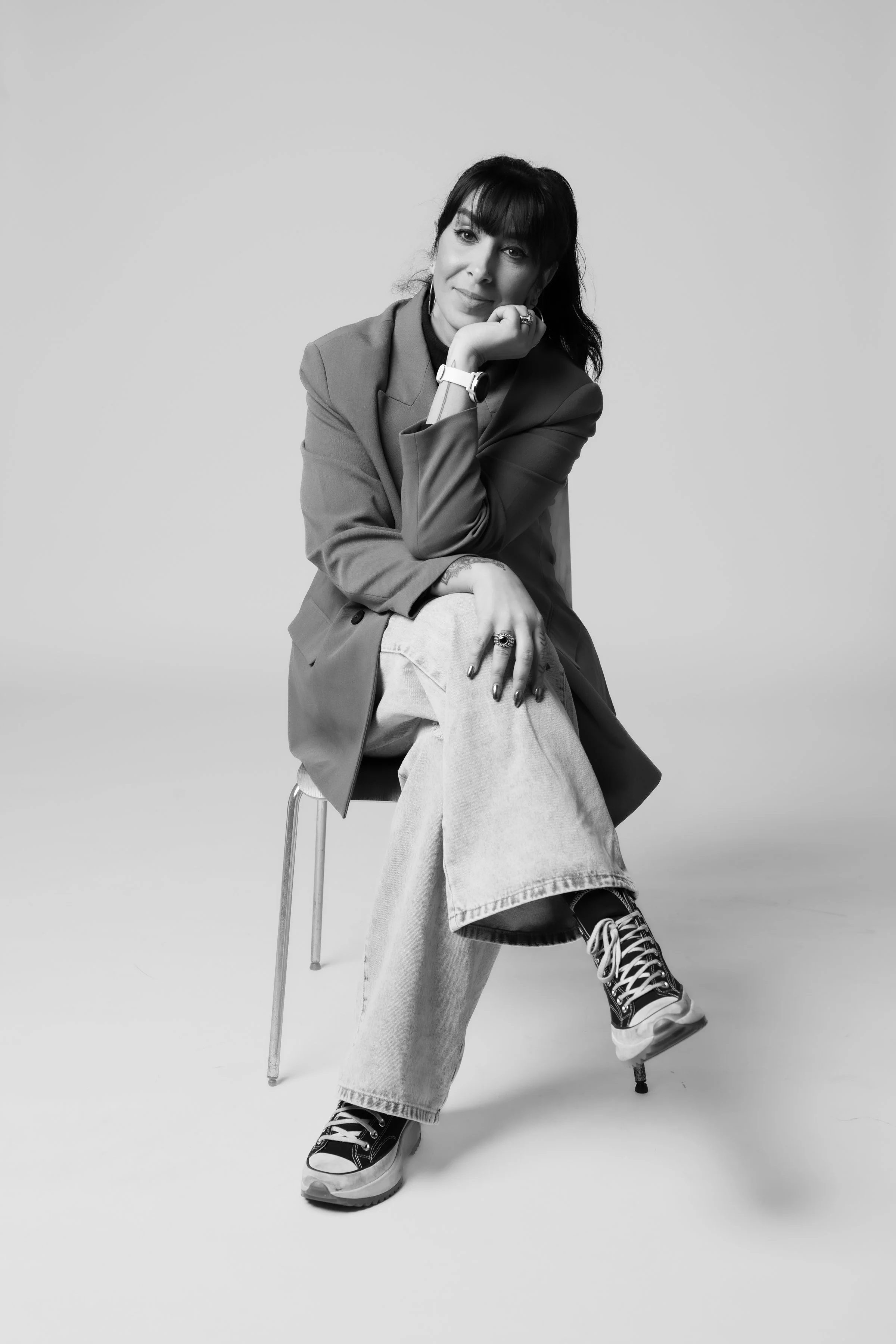
Michelle Grace Hunder - Music Photographer
Q: Let’s start with music photography. How did you get into it? Was it something that began at school?
A: Oh gosh—no! I wasn’t into photography at all at school. I was the sport kid and the music kid. I played every instrument, did VCE music and singing, but photography wasn’t on my radar.
I actually did a photography class in Year 10 and completely stuffed up the final assignment. I was obsessed with the concept and the lighting, but the whole thing came back out of focus—on film. I was devastated. So no, photography didn’t feel like a path back then.
It wasn’t until my 30s. I’d had a business fail miserably and I was pretty lost. My husband gave me a camera for Christmas—he’d noticed I liked taking photos at parties and posting them on Facebook. A couple of friends, including a photographer I used to model for, encouraged me. They said, “There’s something here.”
So I threw myself into it. One of the first people I followed around with a camera was Briggs—an old friend who had just started rapping. He’d crash on our couch, and I’d go with him to gigs. We made some early music videos together. That introduced me to the music scene, and it just snowballed organically. I didn’t even know music photography was a career path. Now it’s been 15 years.
Q: And now you’ve shot covers for Rolling Stone. What’s that experience like?
A: Amazing. When you get the call to shoot a Rolling Stone cover, it’s a huge honour. I’ve done two covers so far—Amy Shark and Jim Jefferies—and both were incredible experiences.
Rolling Stone is very collaborative. You get to be part of the creative vision, work closely with the artist, choose your team, and execute the concept exactly as you picture it. It’s creatively fulfilling and just a lot of fun.
Q: What’s it like being a tour photographer?
A: Life-changing. I’ve seen the world because of touring. It’s unlike any other photography job—part photojournalism, part portraiture, part chaos management.
You document everything: backstage, days off, travel, rehearsals, candid moments, and of course the shows. Show nights are the highlight every time. You also become extremely good at certain skills: speed editing, living out of tiny spaces, surviving buses and vans, functioning with barely any sleep.
I’ve had an amazing decade touring. I absolutely love it. But I will say—age makes the travel and exhaustion harder. Still worth it, though.
Q: How does all that touring affect your family life?
A: I’m very lucky. My husband is incredibly supportive. There was a day I got a last-minute call to go to Paris the next morning, and he just said, “This is the life we chose.”
We don’t have kids, and that’s part of why we can make these choices. He’s very independent, we have a business together but he also has his own projects, so we balance it well.
Honestly, the hardest part is leaving the dogs—especially as they get older. But we’ve always made it work, even in years when one of us is away far more than the other. It’s always been a team effort.
Q: Let’s shift gears completely and talk about vaccines. What happened?
A: I had an adverse reaction to the Pfizer COVID-19 vaccine. It was a very frightening, life-altering experience. At the time nobody really understood what was happening, and honestly, there was a lot of medical gaslighting—just a complete lack of belief for a long time.
It taught me to advocate for myself fiercely. I knew something was wrong, and I had to push until someone finally listened. Recovery took a long time.
It changed my worldview: I had rose-coloured glasses on. I believed the government would look after people if something went wrong. That’s absolutely not what happened. It was extremely disappointing.
Q: Do you think the response would have been different if you were a man?
A: Possibly. I kept being told I “didn’t fit the profile.” Pericarditis and similar reactions were said to be mostly in young males.
But in vaccine injury groups, it actually skewed toward middle-aged women. I don’t know if the studies missed something or if people just weren’t being listened to. But many women were badly affected and not believed.
For me, the biggest disappointment was the government’s refusal to acknowledge or support people with adverse reactions—even as they publicly promised they would.
Q: How do you see things now?
A: I think there’s a lot of overlap between vaccine injury and long COVID—symptoms, experiences, disbelief. Like many people, I wouldn’t have understood it if I didn’t know people affected.
There was also major censorship—accounts suspended or shadowbanned for discussing injuries. If you pretend people don’t exist, you can’t learn from them. Real science requires acknowledging all outcomes, even the uncomfortable ones.
I’m now part of CoVerse, a science-led group advocating for vaccine-injured people. We’re pushing for proper studies, proper support, proper recognition. If I can help prevent this happening to someone else—or someone’s child—that’s worth it.
Q: Looking back at your life and career, any regrets? Anything you’d do differently?
A: Not really. There have been many obstacles, sure, but no regrets. Sometimes I think I wish I’d started photography earlier. But honestly, everything I did before photography shaped me into the businessperson I am now.
A huge part of my success is because I understand business—finance, marketing, client relations. My past careers gave me that.
So no—I wouldn’t change anything. It’s all part of the journey that brought me here.
Q: Thank you, Michelle.
A: Awesome.